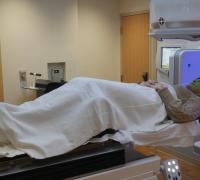
Ultrasound is a test that uses reflected sound waves to produce
an image of organs and other structures in the body. It does not use X-rays or
other types of possibly harmful radiation.
For ultrasound
testing, gel or oil is applied to the skin to help transmit the sound waves. A
small, handheld instrument called a transducer is passed back and forth over
the area of the body that is being examined. The transducer sends out
high-pitched sound waves (above the range of human hearing) that are reflected
back to the transducer. A computer analyzes the reflected sound waves and
converts them into a picture that is displayed on a TV screen. The picture
produced by ultrasound is called a sonogram, echogram, or ultrasound scan.
Pictures or videos of the ultrasound images may be made for a permanent
record.
Ultrasound is most useful for looking at organs and
structures that are either uniform and solid (such as the liver) or
fluid-filled (such as the gallbladder). Mineralized structures (such as bones)
or air-filled organs (such as the lungs) do not show up well on a
sonogram.